
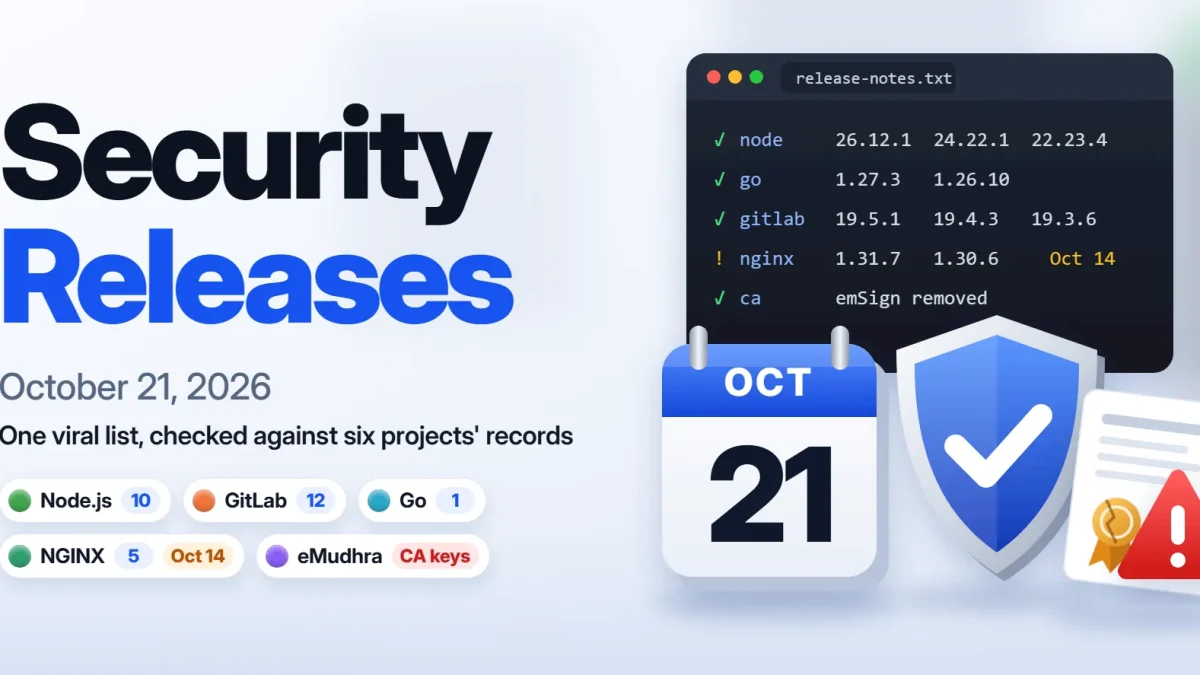
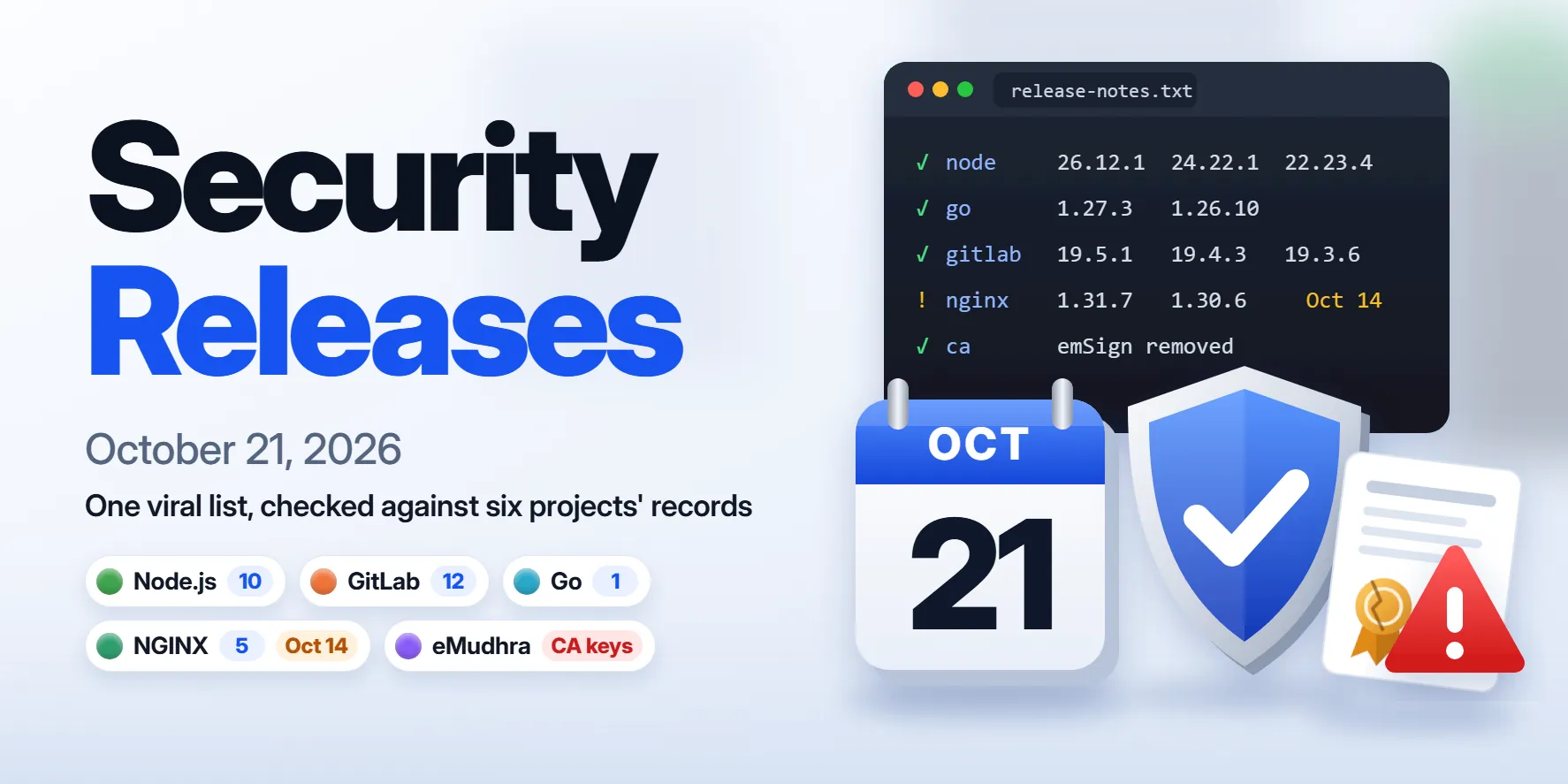
If you run Node.js, Go, GitLab or NGINX, you may have seen the post on X listing the October 2026 security releases. It counts flaws from six projects “in a SINGLE day”. We checked every item against each project’s own records. Five of the six hold up. NGINX’s five fixes are real, but they shipped a week earlier, on October 14.
The list read “PHP 2 CVEs, Node.js 10 CVEs, NGINX 5 CVEs, Go 1 CVE, GitLab 12 CVEs, eMudhra CA certificate compromise”. Every count matches. The timing is looser. Go tagged its fixes at about 01:20 UTC on October 20, and GitLab’s critical CVE record went up at 00:33 UTC on October 22, so the single day is closer to two.
| Project | What was fixed | Date (UTC) | Update to |
|---|---|---|---|
| PHP | 2 critical CVEs, remote code execution | October 21 | 8.2.35, 8.3.36, 8.4.27 or 8.5.12 |
| Node.js | 10 CVEs and a new CA store | October 21 | 22.23.4, 24.22.1 or 26.12.1 |
| Go | 1 CVE, CVE-2026-111943 | October 20 | 1.27.3 or 1.26.10 |
| GitLab | 12 CVEs, 1 rated critical | October 21 | 19.5.1, 19.4.3 or 19.3.6 |
| NGINX | 5 CVEs | October 14 | 1.31.7 mainline or 1.30.6 stable |
| eMudhra | Intermediate CA private keys exposed | October 20 and 21 | A fresh CA bundle |
NGINX is the one miss. Its five CVE records went up at 14:40 UTC on the 14th, alongside 1.31.7 mainline and 1.30.6 stable. The release NGINX did put out on October 21, 1.31.8, lists no security fixes. If you skipped last week’s update, go back for it.
PHP’s two flaws each let an attacker run code on a web server without logging in. This blog runs on PHP, and our guide to the October 2026 PHP security update has the fixed version for each branch and how to confirm your workers picked it up.
Node.js: the Brotli bug comes first
Of the ten, CVE-2026-111497 worries us most. It is an out-of-bounds write in the Brotli decoder, and the Node.js project says it permits remote code execution. Several others let TLS certificate checks be fooled by IP addresses written in odd forms, so a check meant to reject a certificate can pass it.
Node.js 20 reached end of life on April 30, 2026 and got none of these fixes. Teams still on it need a major-version upgrade to patch.
GitLab: one critical bug, fixed four branches back
GitLab’s twelve split into 1 critical, 2 high, 5 medium and 4 low. The two rated high are an LDAP injection and an HTTP request smuggling flaw. The critical one, CVE-2026-110264, is an integer overflow, and GitLab also put its fix into 18.11.13, 19.0.10, 19.1.9 and 19.2.9.
A self-managed instance a few releases behind can close the worst hole without jumping branches. We could confirm those backports only for the critical fix. For the other eleven, plan on the three versions in the table.
Why the eMudhra keys reach past its customers
Every TLS client carries a list of certificate authorities it trusts. A certificate that chains to one of their intermediates passes for the site it names. The private keys behind eMudhra’s emSign intermediates are now “well known”, in the words of RustSec advisory RUSTSEC-2026-0382. Anyone holding them can fake a site to software that still trusts those intermediates. That site never has to be an eMudhra customer.
Two lines of the viral list are partly this story. Go’s single CVE, CVE-2026-111943, makes crypto/x509 refuse chains through these intermediates. Node.js 22, 24 and 26 now ship a CA store without them. Rust programs get the same block from rustls-webpki 0.103.16.
Both checks live inside the compiled program. A Go service is protected once it is rebuilt with Go 1.27.3 or 1.26.10, and a Rust one once rustls-webpki is bumped and the binary rebuilt. Restarting the old binary changes nothing.
Sources
- Node.js, “Wednesday, October 21, 2026 Security Releases”
- Go issue 82345, “crypto/x509: mitigation for security concerns with a specific Certificate Authority” (CVE-2026-111943)
- RustSec advisory RUSTSEC-2026-0382, rustls-webpki and the emSign intermediates
- GitLab CVE record CVE-2026-110264
- NGINX 1.31.7 release notes on GitHub
- NGINX 1.30.6 release notes on GitHub
- Can You Switch Browsers Without Losing Bookmarks, Passwords, and History?

- AI Browser vs Browser Extension: Which Should You Use?

- Are AI Browsers Safe for Online Banking, Shopping, and Personal Accounts?

- Can AI Fill Out Online Forms for You? What Works and What Needs Approval

- Is an AI Browser Worth Switching To? What Everyday Users Should Know

- How Developers Can Connect Coding Agents to a Real Browser

- How Minda Syncs Browser Data Across Computers

- How to Prepare AI-Assisted Research Reports With Verifiable Sources

- Minda Free vs Pro vs Max: Features, Credits, and Plans

- How to Organize Research With Browser Notes and Highlights

- Claude Fable 5.5: The Azure Leak, the Viral Demos and What Is Confirmed

- Minda Privacy Explained: What Stays on Your Computer?

- How AI Agents Can Help SEO Teams With Research and Reporting

- How Minda Combines AI Chat, Research, and Browser Actions

- How to Use Your Own AI Models and API Keys in Minda

- How to Automate Website Monitoring and Routine Checks

- October 2026 Security Releases: Node.js, Go, GitLab, NGINX and eMudhra, Checked
- PHP Security Update, October 2026: CVE-2026-109618 and CVE-2026-109619 Explained
- How to Extract Website Data Into CSV or Excel Without Copying Manually

- Browser AI Agents vs RPA: Which Fits Everyday Work?

- How to Get Started With Minda on Windows, macOS, and Linux

- How AI Agents Help Digital Agencies Manage Multiple Clients

- How Minda Handles AI Actions That Require Your Approval

- How to Use AI for Web Research Without Losing Track of Sources

- How Minda Workspaces Keep Your Accounts Separate

- AI Agents for Freelancers: Practical Ways to Reduce Repetitive Work

- How to Manage Multiple Accounts Without Constantly Switching Logins

- How to Automate Repetitive Browser Tasks With an AI Agent

- Desktop AI Agent Platform: Features, Real Workflows, and How to Choose

- What Is a Super Intelligent Agent?

- What Is a Super Intelligent Browser?

- AI Agent Apps: What Can They Actually Do?

- Can Minda Use Your Computer Like a Human? A Simple Guide for Everyday Users

- Can an AI Agent Plan Your Entire Trip? How Minda Helps From Research to Booking

- Can Minda Manage Your Social Media for You? From Voice Idea to Multi-Platform Posting

- Can an AI Agent Edit Your Website? How Minda Works With WordPress, Shopify and Static Sites

- What Can Minda Do? 5 Core AI Capabilities Explained

- What Is a Super Intelligent Platform?

- AI Agent vs AI Assistant: What Is the Difference?

- AI Browser vs Traditional Browser: What Is the Difference?

- What Is an AI Agent? How AI Agents Complete Tasks for You

- What Is a Desktop AI Agent? A Simple Guide to AI That Works on Your Computer

- What Is an AI Browser? How AI Browsers Work in 2026