

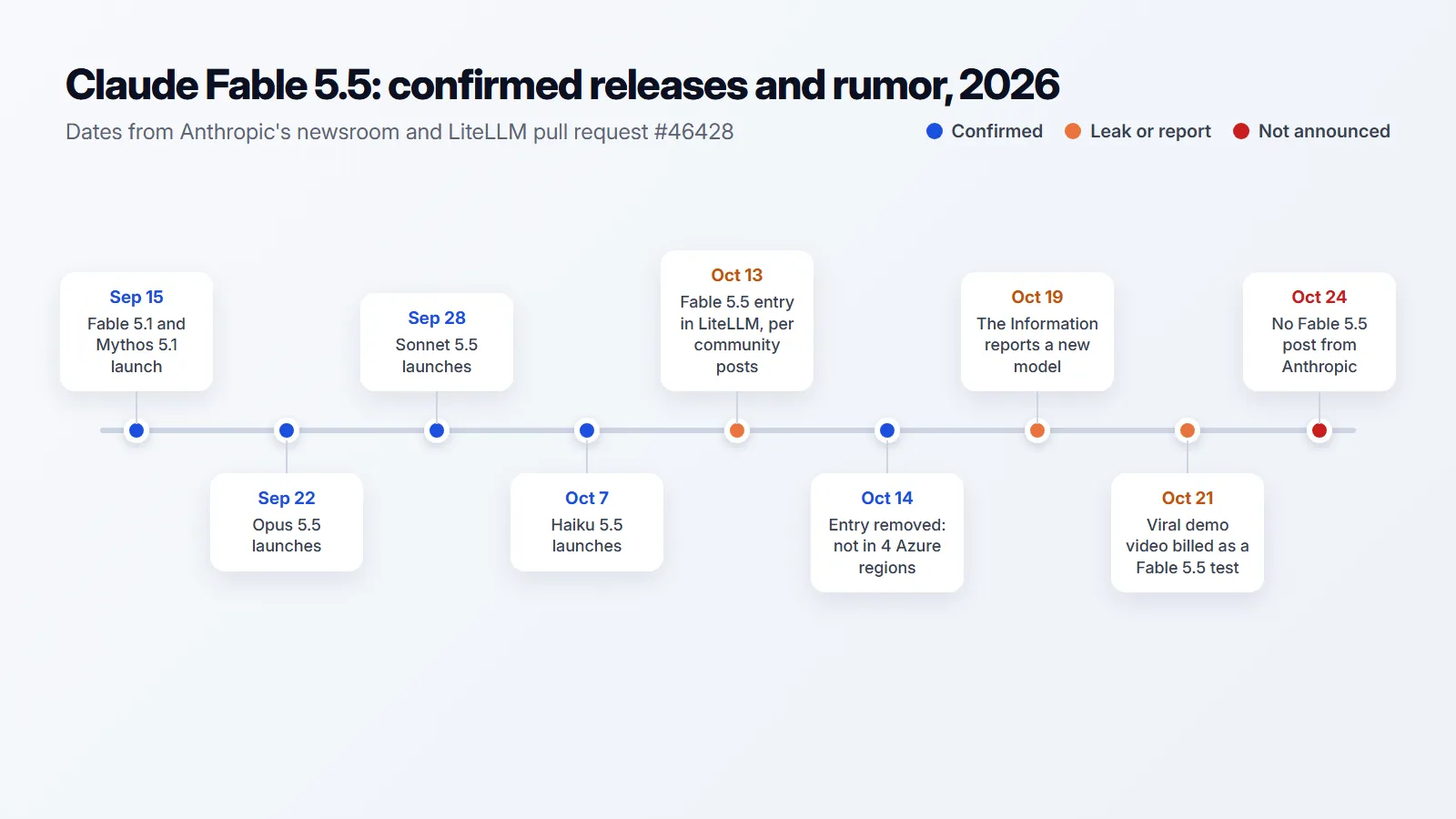
If someone told you this week that Claude Fable 5.5 launches “in a few hours,” hold the repost. We read Anthropic’s newsroom on October 24, 2026. The newest Fable post is still “Introducing Claude Mythos and Fable 5.1” from September 15, and the three model posts since then introduce the 5.5 family of Opus, Sonnet and Haiku. None of them names a Fable 5.5.
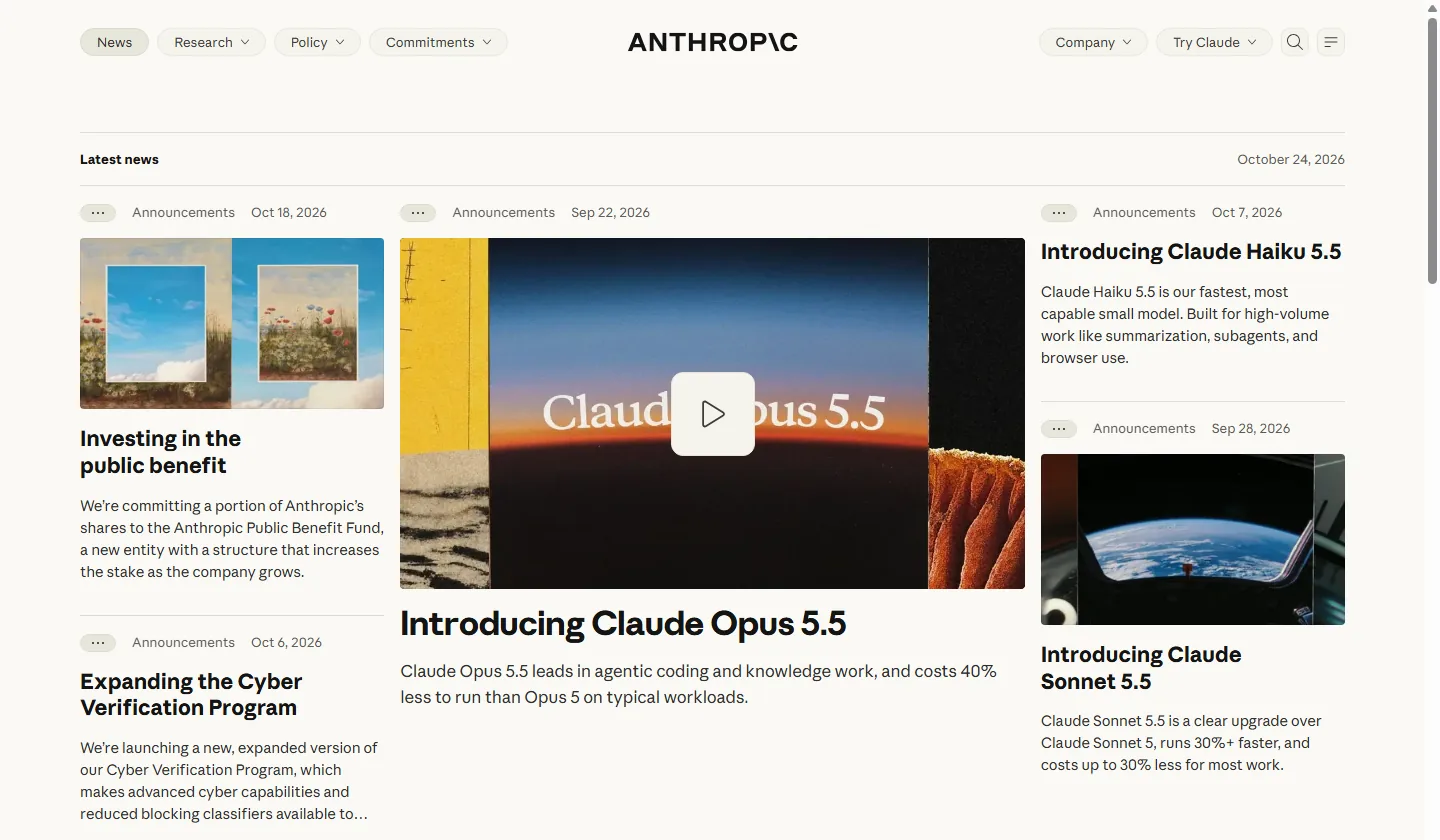
Our view, up front: a Fable 5.5 is a sensible guess about what ships next, the leak behind the rumor is real but proves almost nothing, and the demos are the part worth your time. They show a way of making video that has nothing to do with Sora-style diffusion, and you can use it today with the models already on sale.
Where the rumor came from
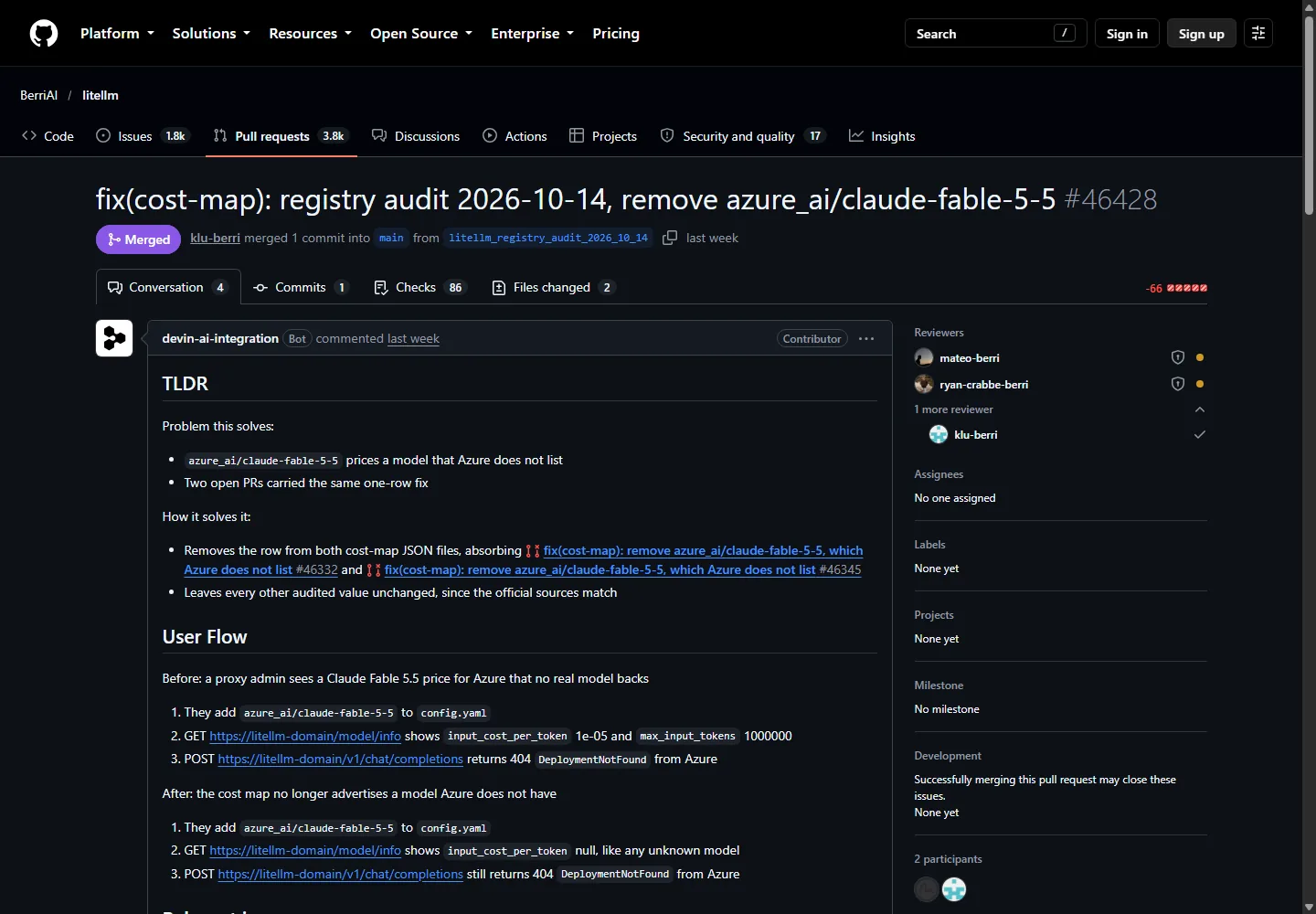
In mid-October, LiteLLM’s model cost map gained an entry for azure_ai/claude-fable-5-5. LiteLLM is the open-source proxy many teams use to route calls across providers, so a new entry there travels fast. Community posts date it to October 13. It was gone the next day.
LiteLLM pull request #46428, titled “fix(cost-map): registry audit 2026-10-14, remove azure_ai/claude-fable-5-5”, merged on October 14. Its audit checked Azure’s Models API in four regions, eastus2, eastus, westus3 and swedencentral, and found the model in none of them. A proxy call to it returned 404 DeploymentNotFound. Two earlier pull requests, #46332 and #46345, had tried the same removal.
The removed entry is in the pull request’s diff. It priced Fable 5.5 at $10 per million input tokens and $50 per million output tokens, with cache reads at $0.25, a 1M-token input limit and 128K tokens of output. Every one of those numbers is Fable 5.1’s. Its source line points at Azure’s model list for the eastus2 region.
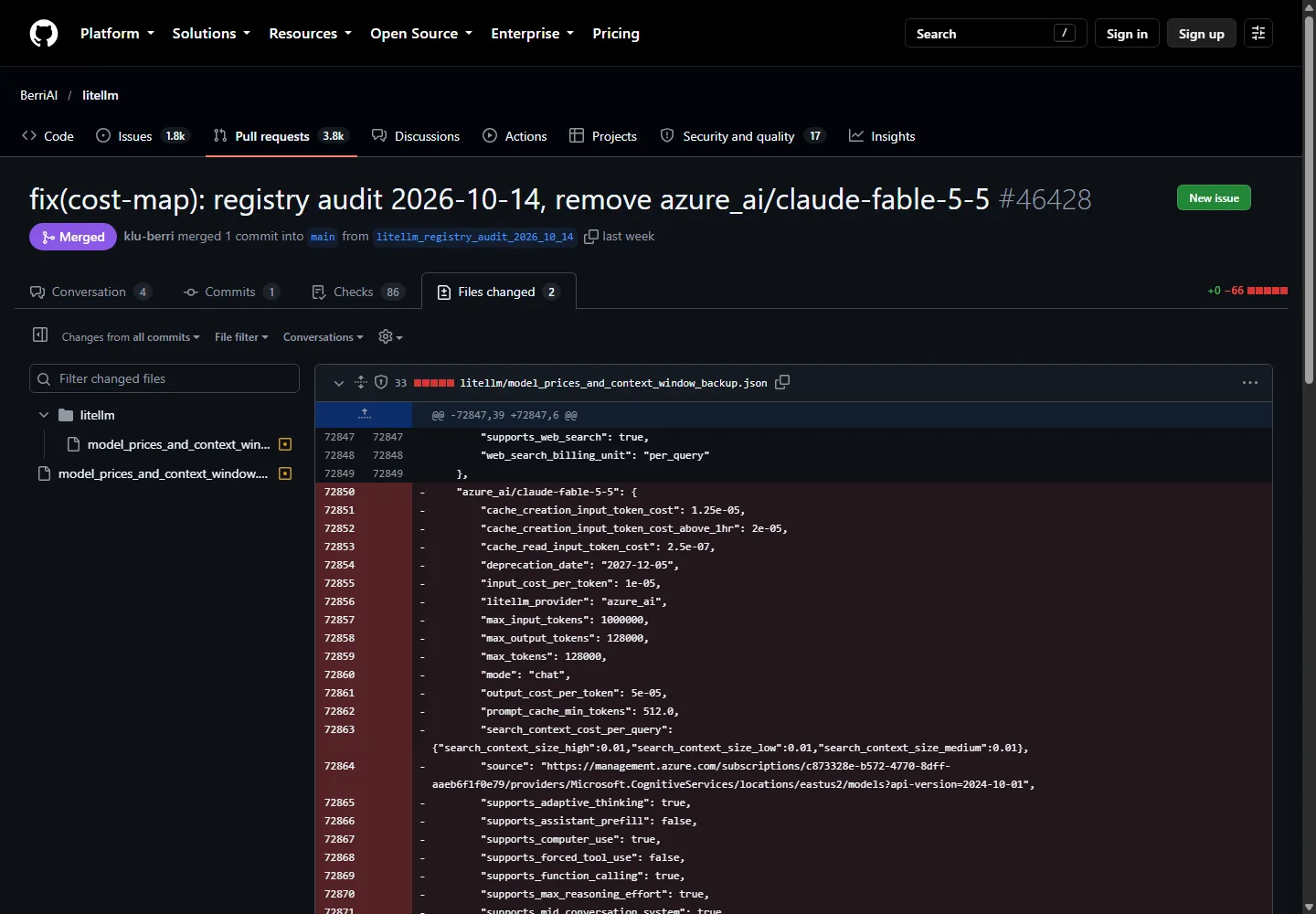
Read that carefully. An entry named a model. Nobody could call it. The most the leak shows is that a model ID with that name surfaced somewhere in Azure’s catalog plumbing, or in a script that reads it, for a short time. It says nothing about a release date, and a price copied from 5.1 is a placeholder, not a leak.
Two more threads feed the story. Model names such as claude-onigiri-eap-2 (“Onigiri”) and “Verrine” have turned up in third-party benchmark and CLI traces shared by creators. We have not seen those traces ourselves. On October 19, The Information reported an upcoming Anthropic model with stronger “intent recognition.” That report is paywalled and we have not read it, so we can’t say whether it names Fable.
So the chain is three 5.5 releases in a row, a one-day catalog entry, two codenames and one paywalled report. On October 21 the YouTube channel AI超元域 posted a video billed as a deep test of Claude Fable 5.5, and the launch talk took off from there. Three days later, nothing.
The 5.5 family, with the rumor beside it
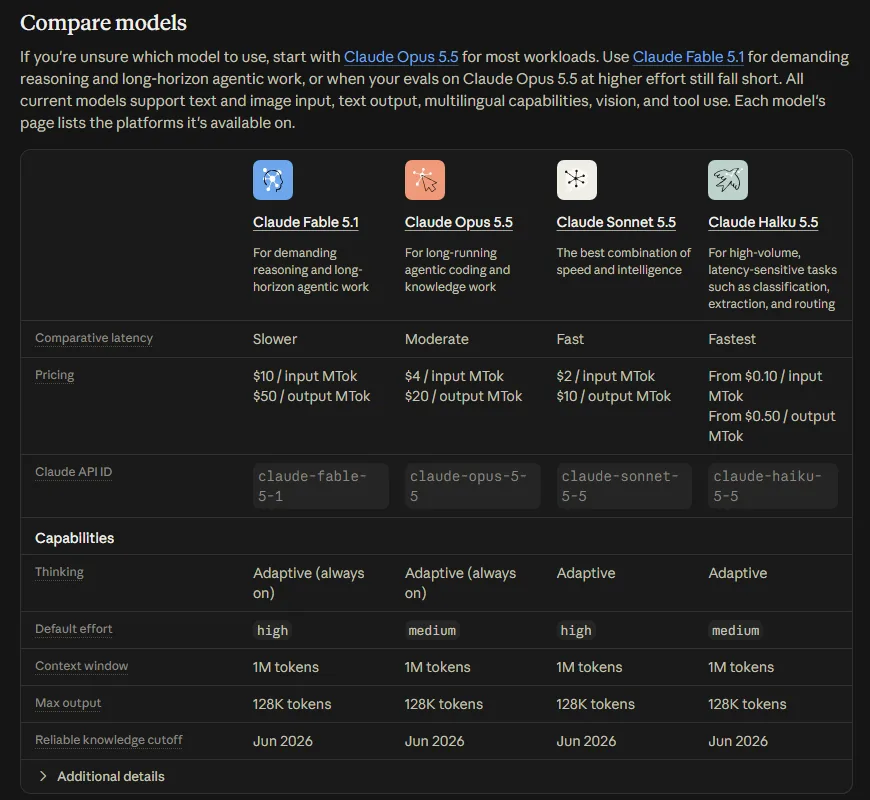
Prices come from Anthropic’s launch posts for Fable 5.1, Opus 5.5, Sonnet 5.5 and Haiku 5.5. The Fable 5.5 row shows what the removed LiteLLM entry contained.
| Model | Status | Released | Input / output per 1M tokens | Cache read per 1M |
|---|---|---|---|---|
| Claude Fable 5.5 | Rumored. Catalog entry removed October 14 | Not released | $10 / $50 (removed entry, same as 5.1) | $0.25 (removed entry) |
| Claude Fable 5.1 | Current flagship | September 15, 2026 | $10 / $50 | $0.25 |
| Claude Opus 5.5 | Released | September 22, 2026 | $4 / $20 | $0.20 |
| Claude Sonnet 5.5 | Released | September 28, 2026 | $2 / $10 | $0.10 |
| Claude Haiku 5.5 | Released | October 7, 2026 | $0.10 / $0.50 (prompts up to 100K tokens) | $0.01 |
Fable 5.1 and Mythos 5.1 are the same model with different safeguards, in Anthropic’s own words. Mythos is limited to trusted-access programs, with safeguards built for cybersecurity and life-sciences work. Fable is the generally available version.
All four released models share the same limits: a 1M-token context window and up to 128K tokens of output per request, according to Anthropic’s model directory. The directory names Fable 5.1 as the pick for “demanding reasoning and long-horizon agentic work” and lists no Fable 5.5.
The row that matters for a buyer is Opus 5.5. Anthropic’s own launch table puts it ahead of Fable 5.1 on all nine benchmarks it lists, at 40% of the price. On GDPval-AA v2.1 it scores 1846 Elo to Fable 5.1’s 1735, and on Terminal-Bench 4.0 it reaches 66.4% to 55.8%. Anthropic adds that “the gap between Opus 5.5 and Claude Fable 5.1 is narrower than these scores suggest,” which is a polite way of saying the benchmarks flatter the cheaper model. Whatever Fable 5.5 turns out to be, it has to justify $10 and $50 against a sibling that already wins the public table for $4 and $20.
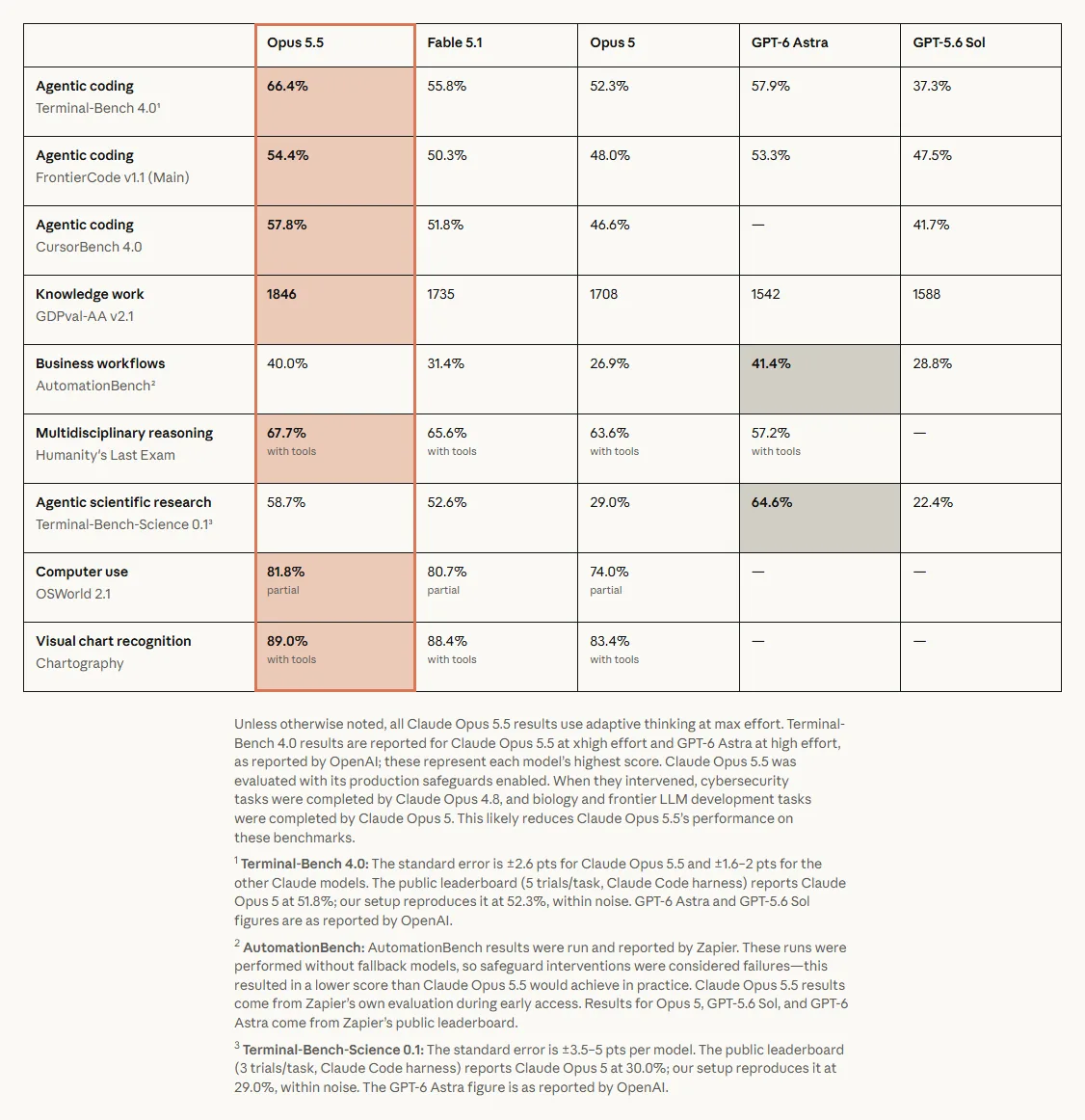
The columns in that launch table were not all run under one roof. GPT-6 Astra’s Terminal-Bench figure comes from OpenAI, and some AutomationBench rows come from Zapier’s leaderboard.
What the screenshots show
The creators behind the viral clips, X user @chetaslua and the AI超元域 channel among them, describe their work as gray-box testing of Fable 5.5. In the screenshots shared alongside the clips, the interface is Claude Desktop or Claude Code, and the model picker shows Fable 5.1 or no model name at all.
That could be a 5.5 candidate. It could be a tuned 5.1. Nobody outside Anthropic can tell from a screenshot, and a desktop screenshot carries no API model ID. Treat “made with Fable 5.5” as a caption, not a fact.
What the clips do show, with no caveat needed, is that a current Claude model will take a prompt and return a finished MP4 with motion graphics and synchronized sound. That is the finding. The version number is noise.
The eight demos
All eight are in the same AI超元域 video, posted October 21 at 13:53 UTC. Its description says every test ran in Claude’s official desktop app. The descriptions below are of the clips as shown. Nobody here ran the prompts.

| # | Demo | Input | What the clip shows |
|---|---|---|---|
| 1 | OpenAI promo clone | 2 posters, 1 logo, 1 generated image, text | Motion typography timed to synthesized sound effects, exported as one MP4 |
| 2 | History of art | Text only | Eras rendered in distinct styles, Van Gogh impasto included, then a cat scene with floor reflections |
| 3 | Daily routine and watch teardown | Text only | A morning-to-night sequence with a mechanical watch coming apart piece by piece, and skyline and running shots drawn in code where no photos were given |
| 4 | Bouncing ball to “5.5” | A short line of text | A ball bounces to self-made collision audio, then becomes the decimal point in “5.5” |
| 5 | Highlighter on a wooden desk | Text only | A highlighter sweeps over text on a procedurally drawn wood grain |
| 6 | Blurred butterflies form a logo | 1 image, text | Motion-blurred butterflies fly in one by one, blur kept, and the last frame matches the input layout beside the logo |
| 7 | Geological eras documentary | One long prompt | A multi-minute timeline from the Ediacaran to the present |
| 8 | The journey of a token | Text only | Text input to tokens, attention layers and output, drawn as an explainer |
Demo 7 is the one to study. One prompt produced a sequence that opens on Ediacaran seafloor mats and moves through Cambrian trilobites and Anomalocaris, an Ordovician Cameroceras, then Silurian fish and the first arthropods on land. It continues with a Devonian Dunkleosteus and a Carboniferous forest with a meter-long Meganeura. A Permian Lystrosaurus runs under camera shake before the volcanic Great Dying. The three Mesozoic periods end in an asteroid strike. Then come terror birds, saber-toothed cats, ice-age glaciers and human settlement from 8,000 BCE to now.
In the sequence as the creator lays it out, each animal sits in its correct period and the periods run in order. The creator ran the same prompt on Opus 5.5 and GPT-6 Astra, says neither went as deep, and limits that comparison to this one animation. We could not check it, and a single creator’s run is not a benchmark.
Demo 8 is the one a software company should copy. It explains how a language model turns a prompt into tokens, runs them through attention and emits an answer. That is the 90-second clip a product page needs, and the kind usually built by hand in After Effects.
How a language model makes an MP4
Claude does not generate pixels. It generates a program that generates pixels, then runs it.
Start with how a motion designer works in After Effects. Every element is a layer with properties such as position, scale and opacity, and each property has keyframes on a timeline. The renderer walks the timeline frame by frame, evaluates every property, composites the layers and writes the frame. A designer sets those keyframes by hand.
The model does the same job in code. Given “a ball bounces three times and becomes the decimal point in 5.5”, it writes a script. That script might be Python with manim or moviepy, JavaScript against an HTML5 canvas, or a React project in Remotion. The script defines the ball as a shape, the bounce as a function of time, and the morph as an interpolation between two paths. A loop renders, say, 30 frames a second for 15 seconds, 450 PNGs.
For sound, the script does not fetch a sample. It computes a waveform, a short decaying sine burst at each bounce timestamp, and writes a WAV. ffmpeg muxes the frames and the audio into an MP4. The agent runs each step in its sandbox, looks at the output, fixes a timing error, and runs again.
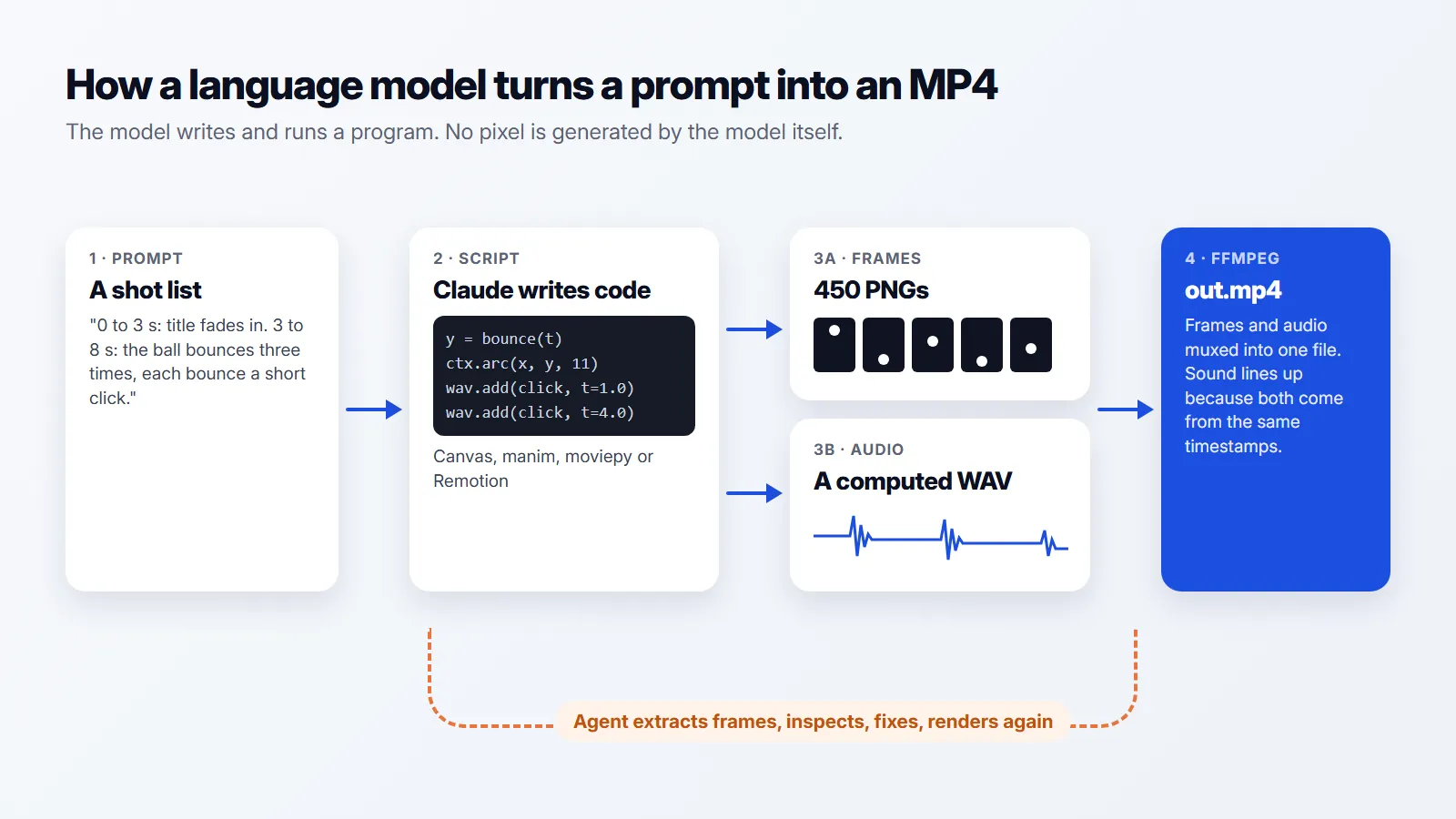
That is why the typography in demo 1 is clean and the butterflies in demo 6 land on their exact input positions. A diffusion model guesses every pixel of every frame and has no concept of a layout it must return to. A script has coordinates. Text is a string drawn with a font, so it never comes out as the melted letters you see in diffusion video. Sound lines up with motion because both are computed from the same timestamp.
The limits follow from the same fact. Nothing here is photoreal. The cat in demo 2 looks good because the lighting and reflection were coded, and that is a long way from a filmed cat. Rendering takes minutes, not seconds, and a two-minute documentary can take a long session with many fix-and-rerun loops. And the model has to know the library it reaches for. When it picks a canvas API it has seen a million times, results are good. When it picks a niche renderer, you get a stack trace before you get a frame.
The upside most people miss is that the output is source code. You can open it, change a color, swap a logo, extend a scene by three seconds, and re-render. A diffusion clip gives you a file. This gives you a project.
Try it today, without waiting for 5.5
Nothing in the demos needs an unreleased model. Opus 5.5, at less than half Fable’s price, is the obvious choice for a first attempt, and Fable 5.1 for a long documentary-style run.
- Install ffmpeg and either Node or Python on the machine where the agent runs. Check with
ffmpeg -version. - Open Claude Code in an empty folder. State the tool chain in the prompt so the model does not pick one at random. For example: “use HTML5 canvas rendered with node-canvas, write frames to ./frames, synthesize audio with a WAV writer, mux with ffmpeg to out.mp4”.
- Describe the video as a shot list with durations, not as a mood. “0 to 3 s: title fades in. 3 to 8 s: the ball bounces three times, each bounce a short click.” The demo 7 prompt was a timeline, not a vibe.
- Expect the first render to be wrong somewhere and let the agent watch its own output. Ask it to extract three frames with ffmpeg and inspect them before it declares the job done.
This prompt, the demo 4 idea shrunk to 15 seconds, can be pasted as is.
Make a 15-second 1080p MP4 at 30 fps. Use node-canvas for frames, write a WAV with a
small sine-burst synthesizer for sound, mux with ffmpeg. Scene: a white ball on a dark
background bounces three times with decreasing height (seconds 1, 4, 7), each bounce
makes a short click in the audio. From second 9 the ball slides to the center and
becomes the decimal point of the text "5.5", which fades in around it by second 12.
Hold to 15. Render, extract frames at 1 s, 7 s and 12 s, inspect them, fix anything
wrong, then report the final file size and duration.
We estimate a run like that at around a dollar on Opus 5.5. An agent session of this size reads a few hundred thousand tokens, most of them cached, and writes a few tens of thousands. The rendering adds nothing to the bill, since the frames and the audio are math and ffmpeg on your own machine.
For chat rather than code, Minda takes your own Claude API key and spends no Minda AI credits on those requests, as our guide to using your own AI models and API keys explains.
What to watch for
A Fable 5.5 announcement will arrive as a post in Anthropic’s newsroom, with a model ID of the form claude-fable-5-5 in the docs and a price. Until it does, a screenshot with a 5.5 logo in it was drawn by a script, which is rather the point.
Last verified October 24, 2026, 06:10 UTC. Release dates and prices come from Anthropic’s newsroom and launch posts, context and output limits from Anthropic’s model directory, and the LiteLLM facts from the pull request and its diff on GitHub. Each screenshot in this post was taken that morning from the page linked under it. The demo descriptions come from the video and the creators’ posts.
Three corrections. An earlier version said we could not open Anthropic’s model directory, so the 1M-token and 128K-token figures were left unchecked. We have since read it, and it confirms both for all four released models. The earlier version also credited the leaked entry’s price to community posts. The pull request’s diff shows it directly, so the post now cites the diff. It also quoted AI超元域 as promising an official announcement “in a few hours.” The video’s title and description say no such thing, and it has no captions we could search, so we removed the quote.
Frequently asked questions
Can I call Claude Fable 5.5 from the API today?
No. Code that asks for it will fail until Anthropic publishes the model, so keep production calls on Fable 5.1 or Opus 5.5 and swap the model ID later. Switching costs one line, because the 5.5 family uses the same Messages API.
Can Claude make a video file on its own?
Not from a plain API call, which returns text and tool calls. The MP4 appears only when the code Claude writes is run somewhere, such as Claude Code on your computer with ffmpeg installed. A chat with no way to run code can give you the script, and you run it yourself.
Can I use these videos commercially?
Check the license of the renderer the model picked. manim and moviepy are MIT-licensed. ffmpeg is LGPL, or GPL when it is built with parts such as the x264 encoder. Remotion is free for individuals, non-profits and companies with up to three employees, and larger companies need its paid company license.
Hand the render to a coding agent
Ask Minda’s AI chat to build the video project and it writes a brief for Claude Code on your computer, then opens the result in a tab. It runs on your own Claude sign-in, so no Minda credits are spent.
Through Minda’s local browser bridge for coding agents, Claude Code can also open the finished page or player in a real tab and check it.
Sources
- Anthropic newsroom, read October 24, 2026: https://www.anthropic.com/news
- Anthropic, “Introducing Claude Mythos and Fable 5.1”, September 15, 2026: https://www.anthropic.com/claude-fable-and-mythos-5-1
- Anthropic, “Introducing Claude Opus 5.5”, September 22, 2026: https://www.anthropic.com/news/claude-opus-5-5
- Anthropic, “Introducing Claude Sonnet 5.5”, September 28, 2026: https://www.anthropic.com/news/claude-sonnet-5-5
- Anthropic, “Introducing Claude Haiku 5.5”, October 7, 2026: https://www.anthropic.com/news/claude-haiku-5-5
- Anthropic, Claude models overview: https://platform.claude.com/docs/en/models/overview
- BerriAI/litellm pull request #46428, merged October 14, 2026: https://github.com/BerriAI/litellm/pull/46428
- The same pull request’s diff: https://github.com/BerriAI/litellm/pull/46428/files
- Remotion license: https://github.com/remotion-dev/remotion/blob/main/LICENSE.md
- manim license: https://github.com/ManimCommunity/manim/blob/main/LICENSE
- moviepy license: https://github.com/Zulko/moviepy/blob/master/LICENCE.txt
- AI超元域 on YouTube, the Claude Fable 5.5 animation test video, October 21, 2026: https://www.youtube.com/watch?v=C8hMcdSYtKk
- Can You Switch Browsers Without Losing Bookmarks, Passwords, and History?

- AI Browser vs Browser Extension: Which Should You Use?

- Are AI Browsers Safe for Online Banking, Shopping, and Personal Accounts?

- Can AI Fill Out Online Forms for You? What Works and What Needs Approval

- Is an AI Browser Worth Switching To? What Everyday Users Should Know

- How Developers Can Connect Coding Agents to a Real Browser

- How Minda Syncs Browser Data Across Computers

- How to Prepare AI-Assisted Research Reports With Verifiable Sources

- Minda Free vs Pro vs Max: Features, Credits, and Plans

- How to Organize Research With Browser Notes and Highlights

- Claude Fable 5.5: The Azure Leak, the Viral Demos and What Is Confirmed

- Minda Privacy Explained: What Stays on Your Computer?

- How AI Agents Can Help SEO Teams With Research and Reporting

- How Minda Combines AI Chat, Research, and Browser Actions

- How to Use Your Own AI Models and API Keys in Minda

- How to Automate Website Monitoring and Routine Checks

- October 2026 Security Releases: Node.js, Go, GitLab, NGINX and eMudhra, Checked

- PHP Security Update, October 2026: CVE-2026-109618 and CVE-2026-109619 Explained
- How to Extract Website Data Into CSV or Excel Without Copying Manually

- Browser AI Agents vs RPA: Which Fits Everyday Work?

- How to Get Started With Minda on Windows, macOS, and Linux

- How AI Agents Help Digital Agencies Manage Multiple Clients

- How Minda Handles AI Actions That Require Your Approval

- How to Use AI for Web Research Without Losing Track of Sources

- How Minda Workspaces Keep Your Accounts Separate

- AI Agents for Freelancers: Practical Ways to Reduce Repetitive Work

- How to Manage Multiple Accounts Without Constantly Switching Logins

- How to Automate Repetitive Browser Tasks With an AI Agent

- Desktop AI Agent Platform: Features, Real Workflows, and How to Choose

- What Is a Super Intelligent Agent?

- What Is a Super Intelligent Browser?

- AI Agent Apps: What Can They Actually Do?

- Can Minda Use Your Computer Like a Human? A Simple Guide for Everyday Users

- Can an AI Agent Plan Your Entire Trip? How Minda Helps From Research to Booking

- Can Minda Manage Your Social Media for You? From Voice Idea to Multi-Platform Posting

- Can an AI Agent Edit Your Website? How Minda Works With WordPress, Shopify and Static Sites

- What Can Minda Do? 5 Core AI Capabilities Explained

- What Is a Super Intelligent Platform?

- AI Agent vs AI Assistant: What Is the Difference?

- AI Browser vs Traditional Browser: What Is the Difference?

- What Is an AI Agent? How AI Agents Complete Tasks for You

- What Is a Desktop AI Agent? A Simple Guide to AI That Works on Your Computer

- What Is an AI Browser? How AI Browsers Work in 2026