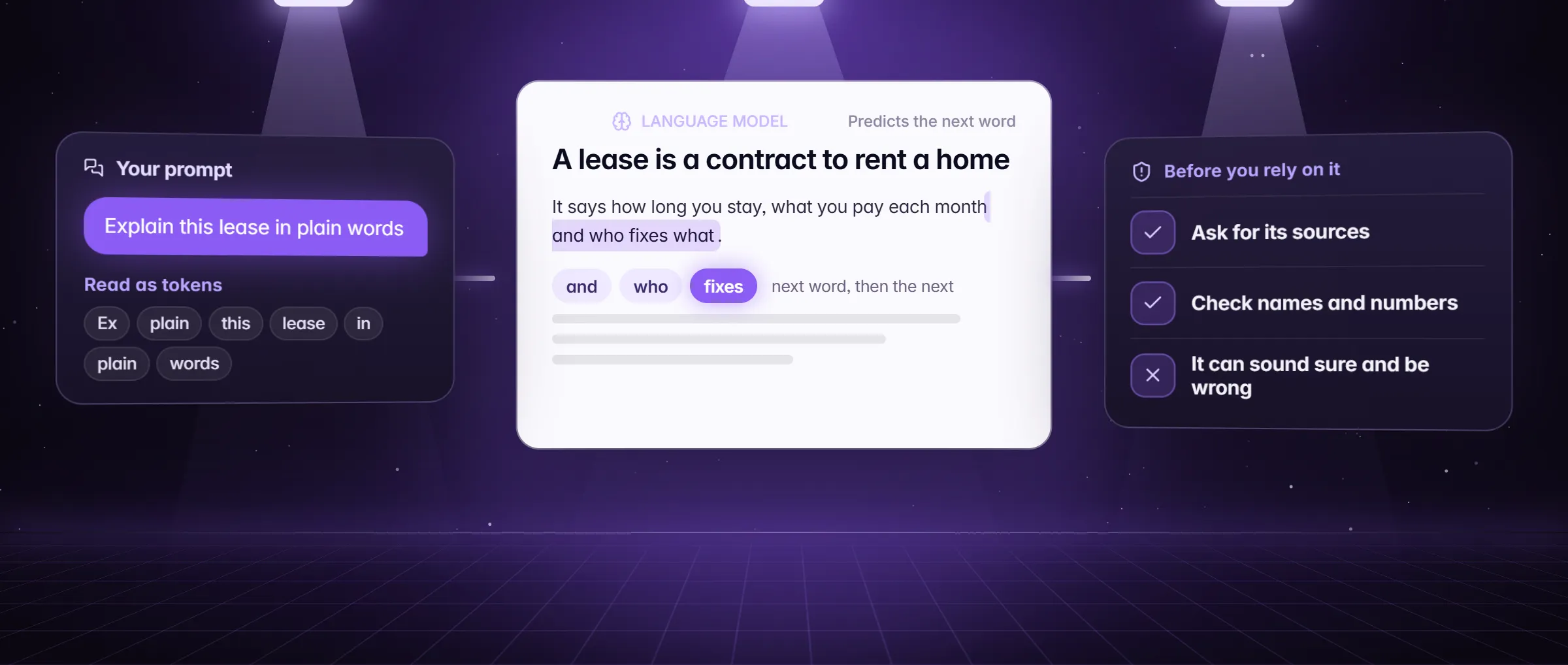
What is a token?
A token is a small piece of text, often a short word or part of a longer one, that an AI model reads and writes one at a time. A short common word is usually one token; a long or rare word is split into several; a comma or a number can be a token of its own. Models count in tokens, not words, because tokens are the pieces they were trained on.
As a rough guide for English, 1,000 tokens is about 750 words, and text in other languages, code and long numbers often take more tokens for the same length. The guide changes from model to model, so treat it as a rule of thumb, not a rate.
What is a context window?
A context window is the most text a model can take into one request, counted in tokens. Your question, the chat so far, every page, file or note you add, and the reply the model writes all share it, so a big request leaves less room to answer. When a request is bigger than the window, something has to go.
Windows differ by model, and Minda publishes no window size per model, so this page quotes none. What Minda does is keep what fits: when a chat is too long for a model, the earliest turns are left out and the newest are kept. For a long document, the SI chat can search your saved pages and notes and read only the passages that match, instead of the whole thing.
How do credits relate to tokens and windows?
They measure three different things. A token measures text, a context window measures room, and a Minda AI credit measures what a request on a hosted model costs. In Minda Super Intelligence each hosted model shows its price in credits a message before you pick it, so you do not have to count tokens to budget. A standard message costs from 1 credit, a premium model costs more, and pictures, voice and video are priced by size and length. A request that sends a lot of text can cost more than one that sends a little. Failed and empty replies are never charged.
Minda publishes no tokens-per-credit rate, so this page gives none. With your own key the provider bills you, and most providers bill by tokens; with Ollama on your computer nothing is billed. Neither uses Minda AI credits.
| Word | What it measures | Who sets it | Where you see it in Minda |
|---|---|---|---|
| Token | A piece of text, often a short word or part of one | The model | The AI activity log lists character counts, not tokens |
| Context window | How much text fits in one request | The model | Minda publishes none per model; a chat too long for a model loses its earliest turns |
| Credit | What a request on a hosted model costs | Minda | The price beside each model, your balance and the credit history |
An example: an Atlanta HOA’s 40-page bylaws
Priya is the treasurer of a homeowners association in Atlanta. A member asks how tall a back-yard fence may be, and the answer is somewhere in the 40-page bylaws.
- Pasting all 40 pages is the wrong first move. At about 500 words a page that is 20,000 words, roughly 27,000 tokens by the rule of thumb, and it may not fit in the model she picked, or it would fill most of it.
- Instead she adds the bylaws to a note in Minda: the note editor reads PDF and Office files.
- She presses Alt+Q for the SI chat and asks: "What do the bylaws say about fence height?" The SI chat searches her saved pages and notes and reads only the matching passages, so the request stays small.
- The answer quotes a section, and she opens that section in the note to check the wording.
- Her next question is about dues, a different topic, so she starts a New chat. The fence passages no longer ride along with the dues request.
What can you use this for?
- Pick a model by its price. Read the credits a message beside each model before you choose, and keep a premium model for the task that needs it.
- Keep a long document manageable. Ask about the part you need, so only that part is read, instead of sending every page with every question.
- Know why a chat drifts. Each message sends the chat so far inside the window; a long, mixed chat fills it and the early turns drop out.
- Budget on your own key. Your provider bills by tokens, so a long chat costs more there than a short one, and a new chat for a new topic costs less.
- Understand a reply that stops short. A model also has a limit on how long one reply can be. Minda carries on a reply cut at the length limit, in the same reply, up to two more times.
How to see and manage it in Minda
- Press Alt+Q to open the SI chat, then open the model menu in the chat box and read the price at the end of each row, in credits a message, before you pick one.
- Start a New chat when the topic changes, so the earlier turns do not ride along with every request.
- For a long document, add it to a note and ask a specific question, so the SI chat finds and reads the matching passages instead of the whole file.
- If a reply stops at the model’s length limit, let it carry on: Minda continues it in the same reply, up to two more times.
- Open Settings → Account → Minda AI credits → History to see what each day used. The server keeps the model, the credits and the time for 92 days, never the words.
Why does a long chat drift, and what do you do?
A chat is not a memory. Each time you send a message, the whole conversation so far goes with it, inside the window. The longer the chat, the more of the window it fills, and once it is full the earliest turns drop out, so an instruction you gave at the start may no longer be there. Even before that, a chat that wanders across topics gives the model more to weigh, and its answers get vaguer.
- One topic, one chat. Start a new chat when the subject changes.
- Say the important thing again. Put the facts and the format you need in your newest message, not only in the first one.
- Attach the source. A page, a file or a note in the request is read as it is; a fact left to the model’s memory is a guess. What is an LLM explains why.
Limits
- Minda publishes no tokens-per-credit rate and no context size per model, and this page gives none: read each model’s price in the chat, and treat 750 words to 1,000 tokens as a rule of thumb.
- The general facts about tokens and windows are general knowledge, not Minda facts, and they differ by model and language.
- Failed and empty replies are never charged. The credit history keeps the model, the credits and the time, never the words, and the AI activity log keeps character counts, not tokens.
Questions
What is a token in AI?
A small piece of text, often a short word or part of a longer one, that a model reads and writes one at a time. As a rough guide for English, 1,000 tokens is about 750 words; other languages and code often use more.
What is a context window?
The most text a model can take into one request, counted in tokens. Your question, the chat so far, anything you add and the reply all share it, and past the limit the earliest text has to go. Windows differ by model, and Minda publishes none per model.
Are credits the same as tokens?
No. A token measures text; a Minda AI credit is what a request on a hosted model costs, from 1 credit for a standard message and more for a premium model. Minda shows each model’s price before you pick it and publishes no tokens-per-credit rate.
Why does a long chat get worse?
Each message sends the whole chat so far inside the model’s window. A long, mixed chat fills it, the early turns drop out, and the model has more to weigh. Start a new chat for a new topic and repeat the key facts in your newest message.
Do tokens matter on my own key or Ollama?
On your own key, yes for cost: most providers bill by tokens, and Minda credits are not used. With Ollama nothing is billed, but the model still has a window. Neither one spends Minda AI credits.
Sources
- minda-facts.json: minda-ai
docs/marketing/minda-facts.json#minda-ai - minda-facts.json: creditPacks (the credit model)
docs/marketing/minda-facts.json#creditPacks - minda-facts.json: ai-chat-own-keys
docs/marketing/minda-facts.json#ai-chat-own-keys - What a request sends, the AI activity log and the credit history: sections 2 and 3
docs/privacy.md - An answer cut at the length limit goes on
docs/project-knowledge.md